By Mafijur Rahman, from Coastal Region
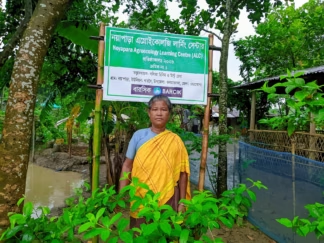
Reena Rani, a woman farmer from Khosalkhali village in Burigoalini Union of Shyamnagar Upazila, Satkhira, has turned adversity into an opportunity through hard work and determination. Despite family difficulties, her husband’s second marriage and the responsibility of raising her children, she has built an integrated farming system on just 66 decimals of homestead land. Today, her homestead provides diverse food for her family while generating income from multiple sources. Her journey is an inspiring example of how women can achieve self-reliance by making the best use of local resources.
Overcoming family challenges through farming
Reena once lived with her husband, son, daughter and mother-in-law. However, her husband’s second marriage brought significant changes to her life. She had to manage a separate household with her children and mother-in-law, taking responsibility for food, daily expenses and her children’s education. Rather than depending on others, she decided to use her available resources to support her family. She began growing vegetables around her homestead, raising fish in her pond and rearing cows, goats, ducks and chickens. Gradually, these activities became the foundation of her family’s food and financial security. Today, her 66-decimal homestead, including the pond, is her most important livelihood resource.
Learning and practicing agroecology with BARCIK
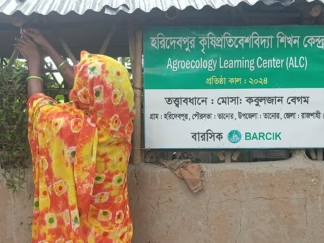
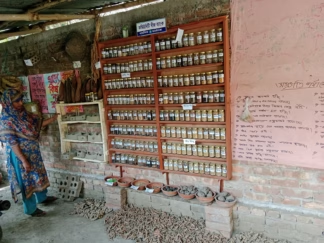
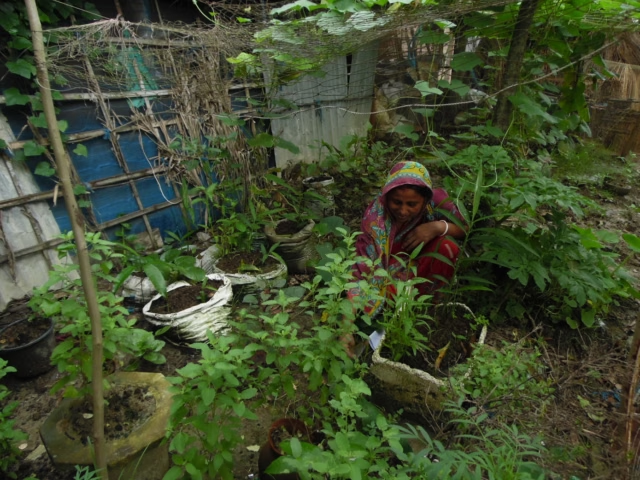
Reena had some contact with BARCIK from 2024 and became directly involved in its activities in 2026. Through training sessions, discussions and experience-sharing activities, she gained knowledge of agroecological farming practices. She learned to produce and use vermicompost, prepare organic pesticides, collect and conserve local seeds, and recognize the value of uncultivated plants. Discussions on topics such as ‘Household Compost for Healthy Soil’, ‘Crop Diversity and Mixed Farming’ and ‘Uncultivated Plants as Our Resources’ helped to broadening her understanding of sustainable agriculture. She began applying these ideas by making productive use of every available space around her home. Vegetable cultivation, fish farming and livestock rearing are now integrated into her homestead system, with the different components supporting one another.
Forty-Six types of food from 66 decimals of land Reena
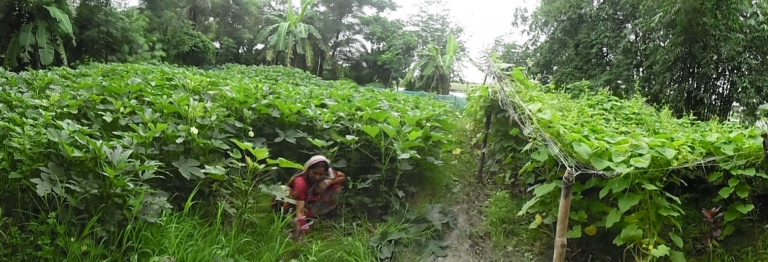
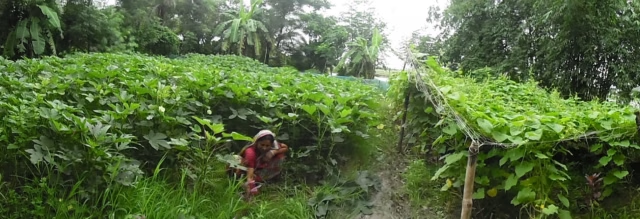
Reena’s homestead has become an important source of food and nutrition throughout the year. She grows around 24 types of vegetables, including yardlong beans, okra, tomato, papaya, bottle gourd, cucumber, pumpkin, spinach, taro, chilli, coriander and drumstick. Her pond contains 12 varieties of fish, including rohu, catla, silver carp, bata, tilapia, mrigal, punti, mola and tengra. She also produces seven types of fruits, including mango, guava, coconut, banana and sapodilla. Eggs, milk and poultry meat further enrich her family’s diet. Altogether, her homestead provides access to approximately 46 types of food, contributing significantly to household food diversity and nutrition. Reena said, “Previously, we had to buy almost all our vegetables from the market. Now we produce different vegetables, fruits and fish throughout the year. My family has access to nutritious food, and we rarely need to buy vegetables.” She also exchanges surplus vegetables with neighbours, strengthening relationships and encouraging mutual support within the community.
Seven sources of income
Reena’s integrated farming system contributes to both household consumption and income. She earns cash from seven sources: vegetables, fruits, fish, ducks, chickens, eggs and milk. According to her estimates, these activities generate an average monthly income of Tk 5,000, or approximately Tk 60,000 annually. In addition, home-produced food saves her family around Tk 4,000 in monthly food expenses, equivalent to Tk 48,000 a year. Together, the annual income and savings amount to approximately Tk 108,000. This financial contribution helps to cover household expenses and her children’s education. “Now I cultivate seasonal vegetables throughout the year, along with fruits and fish. After meeting our family’s needs, I sell the surplus to support household expenses,” she said.
Building a better future for her children
Despite the difficulties she has faced, Reena has never lost sight of her children’s future. Her farming activities help her manage household expenses and continue supporting their education. Through her own labour and determination, she has established an independent livelihood and a stronger role in family decision-making.
A homestead that inspires others
Reena’s homestead is more than a source of family food and income. It demonstrates how limited land can support an integrated and environment friendly farming system. Her experience offers valuable learning opportunities for other farmers, particularly women interested in year-round vegetable cultivation, seed conservation and livestock rearing. Farming in the coastal region remains challenging because of salinity, cyclones, tidal surges, excessive rainfall, waterlogging and water scarcity. Yet Reena continues to make productive use of her available resources despite these difficulties.
Conclusion
Reena’s story is not simply about agricultural success. It is about a woman who refused to surrender to family hardship and instead built a livelihood through courage, experience and hard work. With approximately 46 types of food available from her homestead, seven sources of income, Tk 60,000 in annual sales and Tk 48,000 in food-cost savings, Reena demonstrates how small-scale integrated farming can strengthen household food security and economic independence. Today, she is sustaining her family and investing in her children’s future and setting an inspiring example of women’s leadership, self-reliance and agroecological farming in coastal Bangladesh.